Print-on-Demand in 2026: Can Your Design Earn the Price?
Test a print-on-demand offer through the buyer, physical sample, and delivered economics instead of relying on market-size forecasts.
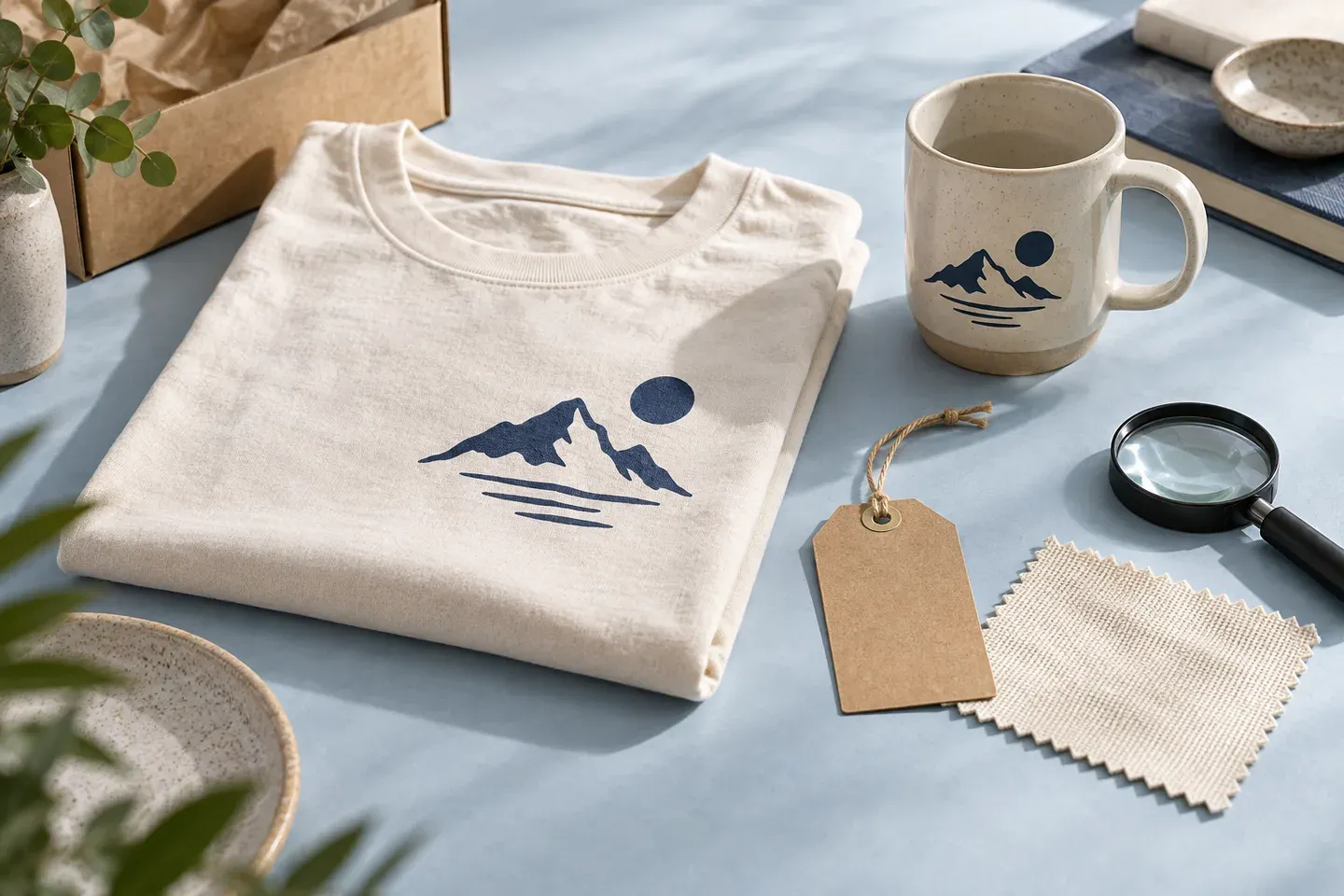
Print-on-demand removes the need to buy a large batch of finished products before you know whether they will sell. It does not remove the need for someone to want your design at the price you need to charge.
Printful’s June 2026 profitability article makes the case for the model. Our starting point is a smaller question: can one particular offer earn its delivered price from one identifiable audience? A growing industry cannot answer that for your store. Printful’s 2026 profitability discussion.
You can investigate that question before filling a catalog with designs.
Choose the buyer before the blank product
Start with a situation you understand. Someone buying a gift for a local walking group is making a different choice from someone who wants a plain everyday shirt. The design, product, presentation, and acceptable price follow from that difference.
Be specific without inventing demand. “A gift for people who walk this coastal route” is a useful hypothesis. “Everyone loves outdoor clothing” is not.
Look at what the audience already buys and what they complain about. The free product research guide explains how to keep those observations separate from unsupported sales claims.
A design does not become distinctive merely because an image generator produced it. Ask whether it expresses something the buyer recognizes and cares about. A random graphic on a standard mug is easy to create and easy to ignore.
Decide which part deserves a premium
Write down why this version should cost more than a generic alternative. It might be a considered design, a well-chosen garment, useful personalization, or a gift presentation that suits the occasion.
Then find evidence for that value. If comfort is central, inspect the garment. If the artwork contains fine detail, inspect the physical print. If personalization is the selling point, check the preview and correction process.
Do not let the mockup do all the persuasion. The delivered item has to carry the same argument.
Order a sample that can disprove your idea
A sample is most useful when it tests a weak point. Choose the dark garment if contrast is uncertain. Check the smallest design size if fine lines may disappear. Try the product in normal use and follow its care instructions.
Printful provides sample-order and manual-order routes for evaluating products. Check the conditions in your account and use the actual design you intend to sell. Printful sample orders, manual orders.
Photograph the received item in ordinary light. Compare color, placement, scale, material, and packaging with your storefront. A technically acceptable print may still be wrong for the price or audience you have in mind.
If you would hesitate to give it to the person you described earlier, keep working on the product.
Calculate what the first order leaves
Use the delivered cost of the exact product and destination. Printful’s payment guide separates shipping from the product price, so do not stop at the catalog figure. Printful payment guide.
Suppose an illustrative shirt sells for $34, with $13 production, $5 shipping, and $2 in transaction and platform costs allocated to that order. It leaves $14 before advertising, returns, design work, and fixed overhead. If acquiring the buyer costs $9, $5 remains before those other costs.
Those are invented figures, not Printful prices or an earnings forecast.
Now decide whether the offer can support its remaining expenses. Do not justify a weak first order by assuming the customer will return repeatedly unless you have evidence for that behavior. A good margin calculation includes the costs that make the idea inconvenient.
Ask for useful feedback, not encouragement
Show the real sample and the real delivered price to people who resemble the intended buyer. Ask what they think it is for, what they would compare it with, and what would stop them ordering.
“Looks nice” is not a purchase decision. Neither is a friend’s promise that they would buy one someday.
If you run a small paid test, set the budget and decision criteria beforehand. Record the offer, audience, and price so you know what the result actually tested. A poor response to one photograph is not proof that the entire niche is dead, but repeated uncertainty about the design’s relevance deserves attention.
Keep the first collection small
A few designs with a clear relationship are easier to explain, sample, and improve than fifty unrelated uploads. Fewer combinations also make it easier to keep mockups, size information, and availability accurate.
AI can help develop concepts, but use original work you have the right to sell and inspect every final asset. Avoid adding someone else’s brand, character, or artwork simply because it appears in a trend feed.
Our recommendation is to proceed when the audience makes sense, the sample supports the price, and the order economics leave room for mistakes. If one of those is missing, solve it before expanding the catalog. More listings multiply the work; they do not settle the question.
Reviewed September 10, 2026. This is an independent offer-testing framework, not a claim about typical POD earnings. Examples are hypothetical; no supplier sample was ordered for this article.
Research and editorial
The in-house team responsible for tool reviews, comparisons, and workflow guides.